Welcome!

Welcome to Research Demystified where the mysteries of social science research will be explored in the context of politics, policy, public administration, program evaluation, measuring for results and advocacy.
This site will provide some “how to do it” guidance as well as focus on how to assess the credibility of research results.Research Methods for Public Administrators

I have set up this blog to look at current issues in the news from a research perspective. The basic question is always: are these research results–the statistics and the conclusions–credible? I invite you to join the conversation and share what makes sense to you, what does not, and why.

I will be posting material that professors can use in classes as well as material for the general public who want to enhance their skills in critiquing research results.

Gail


Challenging Belief that the Very Wealthy are Job Creators

TED Talk: Income Inequality:  Challenges belief that the wealthy are job creators. He argues that it is the middle class, the consumers, who drive the economy. Worth seeing.

TED Talk by Nick Hanauer


Support for Same-Sex Marriage Rising

Nate Silver posted this on his blog:


Source:  Nate Silver’s Blog

The date, he says: “According to surveys included in the PollingReport.com database, an average of 50 percent of American adults support same-sex marriage rights while 45 percent oppose it, based on an average of nine surveys conducted in the past year.”

President Obama came out in support of same-sex marriage. However, Nate Silver notes:

“It should be remembered that support for same-sex marriage in polls has not necessarily translated into support at the ballot booth. On Tuesday, North Carolina became the latest state to adopt a Constitutional ban on same-sex marriage and did so by a margin of about 20 percentage points, somewhat larger than polls forecast. The North Carolina measure also banned domestic partnerships and other types of civil unions.”


Fact is Dead?

Driving home from the store, a story came on about how Facts have died.  So I googled it.  Rex Huppke, a Chicago Tribune reporter wrote the story,

Leading with a headline:

Facts, 360 B.C.-A.D. 2012

In memoriam: After years of health problems, Facts has finally died.

April 19, 2012  By Rex W. Huppke, Chicago Tribune reporter
He wrote:
“To the shock of most sentient beings, Facts died Wednesday, April 18, after a long battle for relevancy with the 24-hour news cycle, blogs and the Internet. Though few expected Facts to pull out of its years-long downward spiral, the official cause of death was from injuries suffered last week when Florida Republican Rep. Allen West steadfastly declared that as many as 81 of his fellow members of the U.S. House of Representatives are communists….

Facts is survived by two brothers, Rumor and Innuendo, and a sister, Emphatic Assertion.  Services are alleged to be private. In lieu of flowers, the family requests that mourners make a donation to their favorite super PAC.”

Article can be found at: Facts is Dead

Read the rest of this entry »


State Governments: Seen More Favorably than Federal Government

PEW reported today: “The gap between favorable ratings of the federal government and state and local governments is wider than ever. Just a third of Americans have a favorable opinion of the federal government, the lowest positive rating in 15 years. Yet opinions about state and local governments, on balance, remain favorable.

The favorable rating for the federal government has fallen to just 33%; while nearly twice as many (62%) have an unfavorable view, according to the latest survey by the Pew Research Center for the People and the Press, conducted April 4-15. By contrast, ratings of state governments remain in positive territory, with 52% offering a favorable and 42% and unfavorable opinion of their state government. Local governments are viewed positively by roughly a two-to-one margin.

Ten years ago, roughly two thirds of Americans offered favorable assessments of all three levels of government: federal, state and local.”

Find report at:Growing Gap


A Reminder: Headlines Might Not Really Tell the Story

The NY Times led with a headline “Exxon Mobil Earnings Disappoint,” (April 27, 2012).  Just glancing at the headline, you might think think the oil corporation had done poorly or had not made much of a profit.  However, that is not the case although the data is a bit confusing. Yes, they say their net income dropped 11 percent for the quarter. They posted a $9.45 billion profit as compared to $10.7 a year earlier.  However, their revenue rose 8.8 percent to $124.1 billion. 

The “disappointment” was becauseExxon did not meet Wall Street expectations of: 1) earing $124.8 billion in revenues, and 2) the price per share was only $2 rather than an expected $2.10.   Most of the article was about how well Shell was doing.

Not really about public administration, but it is a good reminder that just glancing at headlines–as I often do–can be misleading.

Find NY Times Article here


Federal Income Tax Receipt–2012

The National Priorities Project has provided a report on our federal tax dollars at work.

“While you may not get a receipt from the IRS any time soon, National Priorities Project went ahead and wrote one up. This receipt shows where $2,654 in income taxes was spent by the government in fiscal 2011. That’s an estimate of the taxes paid by a single person earning around $30,000 annually.”

It should be noted that they do not include payroll taxes that are designated for Social Security and Medicare Trust Funds.

Still, it is an interesting way to present budget data.

Source: National Priorities Project: http://nationalpriorities.org/en/analysis/2012/taxday-2012/your-tax-receipt/


What the Public Knows about the Political Parties

PEW has a quiz: what do you know about U.S. major political parties? Take the Quiz.  It’s fun.

The quiz goes with the report PEW just released:  What the Public Knows About the Political Partie–report

They lead off saying:

“Most Americans can correctly identify the relative positions of the Republican and Democratic parties on the major issues of the day. But a review of what Americans know about the political parties shows that the public is better informed about the partisan affiliations of two popular recent presidents – Ronald Reagan and Bill Clinton – than it is about the positions of the parties on key issues that dominate the current national debate.”

It also provides some analysis based on age, education, and political identification.


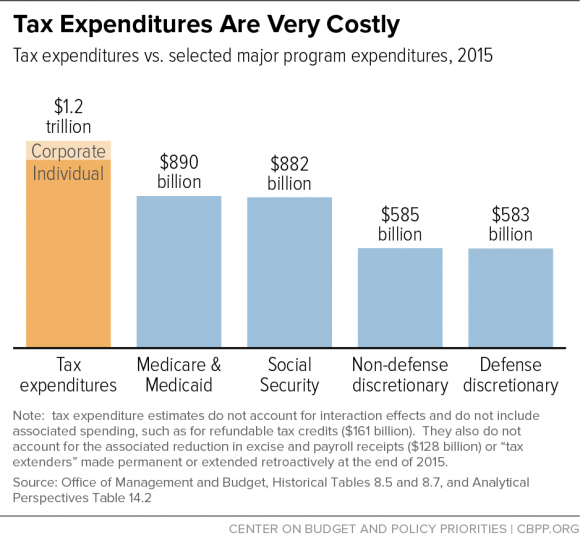
Tax Breaks Add Up To $1.1 Trillion, As Much As Federal Budget Deficit

A former student posted this Huffington Post article on my facebook page. HuffingtonPost article Needless to say that got my attention. The author, Alexander Eichler, leads off the article:

“Take all the tax breaks in the U.S. tax code and put them together.
You’ll find that they add up — and up and up.
That’s the conclusion of a recent report from the Congressional Research Service, an arm of the Library of Congress that provides research and analysis for federal lawmakers. In a report issued last week, the CRS found that all the major tax breaks currently in use in America add up to about $1.1 trillion a year.”

Coincidentally, that is about the size of the FY 2014 projected budget deficit.

Of course, to get into the tax code is very complicated and requires more than a bit of geekiness, which I mean in a good way. So, I have downloaded the CRS report. Read the rest of this entry »


Excellent Sources of Election Information

For political junkies, there are several websites that provide useful data.
One is a site that tracks voter participation. The percent of eligible voters who are actually participating in primaries is rarely reported in the news stories. Some wins are just not representative of many voters.
It can be found at: U.S. Elections Project
It is maintained by Dr. Michael McDonald, an Associate Professor at George Mason University. This is a great public service. Thank you! He also provides participation tables on primaries and general elections for even years from 2000-2010. With this data, you can determine whether voter participation is different in 2012 than in prior years, if you are looking for a research project.
You would need to look at other sources to find out who won those primaries though. The NY Times provides a table of the delegate counts, which shows who won. Another interesting research project is to try and determine whether there is anything about the percent of voter turnout and who wins. Read the rest of this entry »


Performance Measurement–for College Students

I just came across this. A proposal to provide perspective college students with a scorecard to compare costs and a fact sheet showing what it will cost to go to college and what the loan repayment will likely be.

College Scorecard: Scorecard
Cost Disclosure: College Cost Disclosure Sheet


Many of you are in college. What do you think of these? Are they helpful?